News and Insights
2026.07.10Column
Strength Beneath the Surface: The Physical Discipline of Kenbu

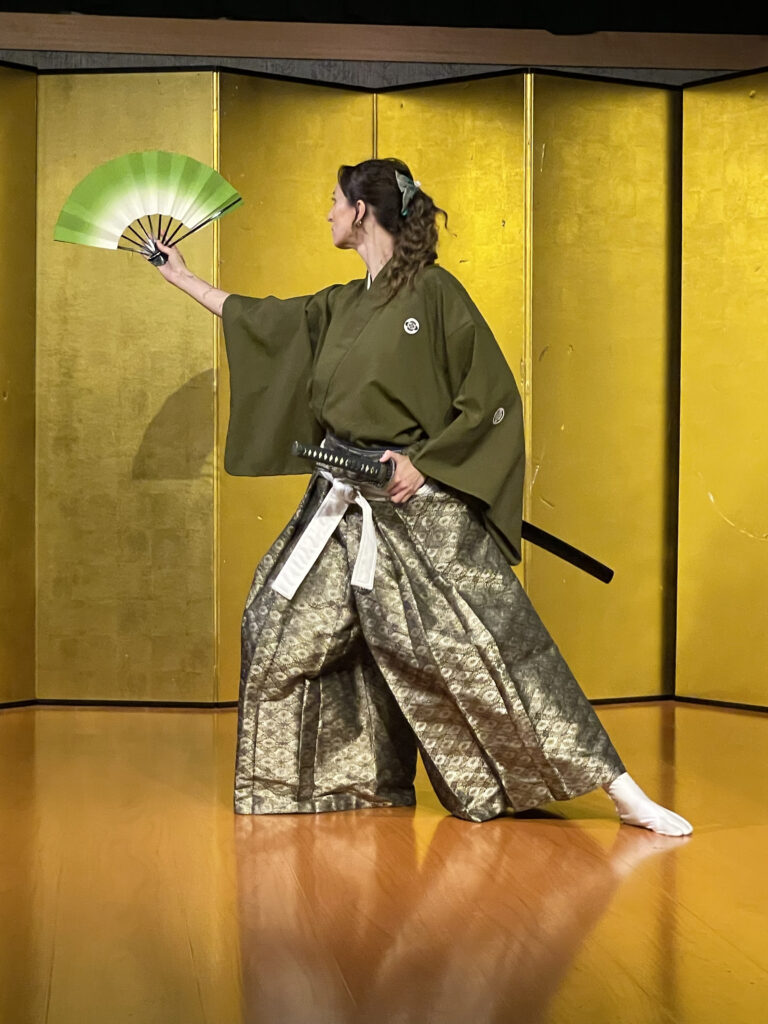
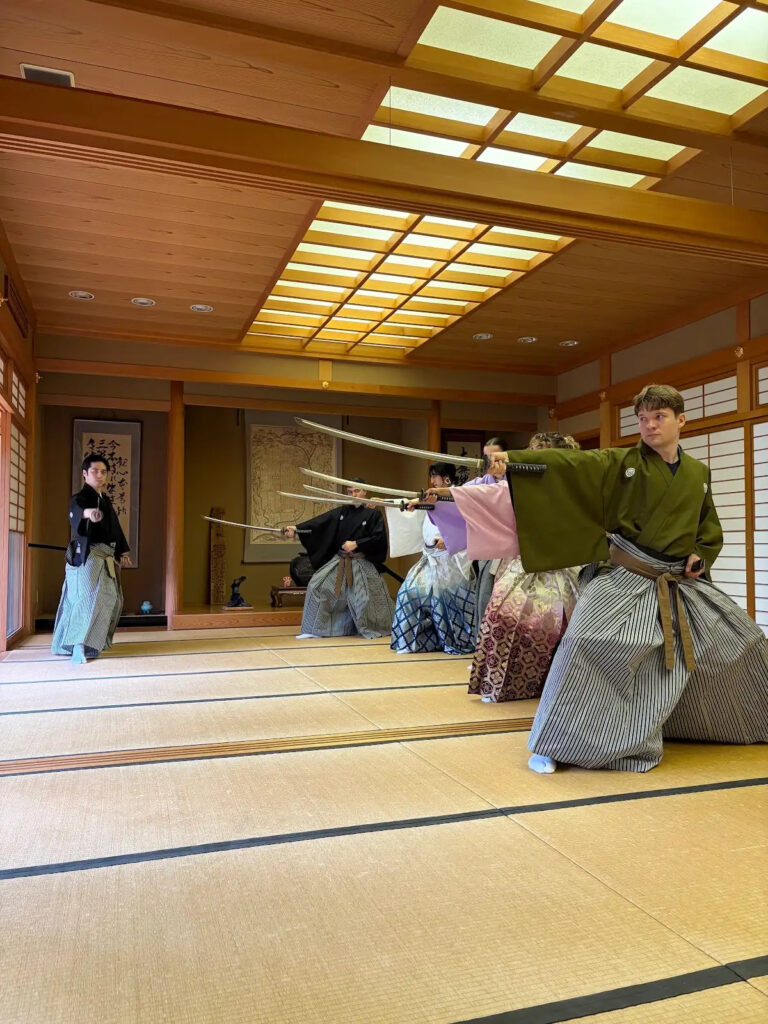
Graceful, controlled, and seemingly effortless—these were myfirst impressions of Kenbu. Watching experienced performers, it is easy to focus on the elegance of the movements, the precision of the sword, and the seamless flow between techniques. What is far less visible is the physical training that makes those movements possible.
As my own training progressed, I came to appreciate just how demanding that training can be. Beneath every controlled cut, turn, or pause lies a constant awareness of posture, balance, muscular control, and coordination. Movements that initially appeared simple often proved surprisingly challenging, requiring far more physical effort than I had expected.
Coming from a background in theatre and movement training, I was already familiar with the importance of posture and body awareness. Even so, Kenbu required me to rethink many habits I had developed over the years. Rather than relying on larger, expressive movement, I found myself concentrating on smaller adjustments: lowering my centre of gravity, refining my balance, and learning how to move efficiently without unnecessary tension.
Looking back, I realise that some of the most valuable lessons were not learned through mastering choreography, but through developing the physical foundations that support every aspect of performance.
The Physical Demands of Kenbu Performance
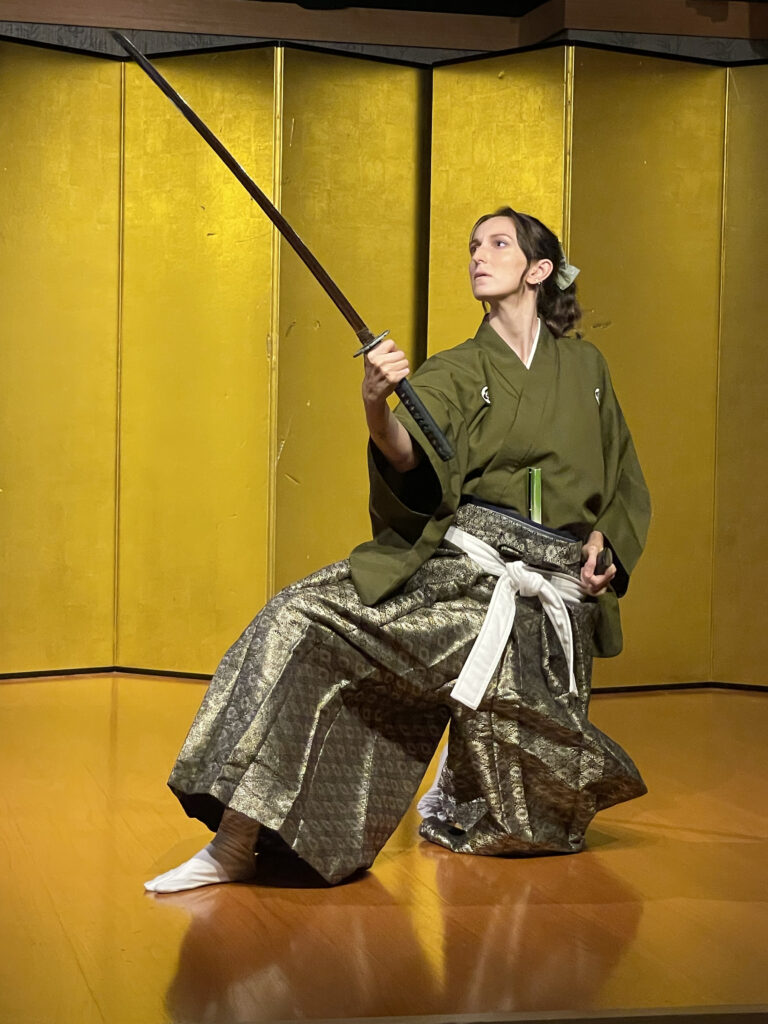
One of the earliest surprises during my training was discovering how physically demanding even the simplest exercises could be. Before learning complete choreography, much of my practice focused on the fundamentals, particularly suriashi—a sliding method of walking in which the feet remain in constant contact with the floor.
Although the movement appears straightforward, maintaining it correctly requires continuous muscular engagement. Keeping a low centre of gravity while remaining upright, avoiding unnecessary vertical movement, and gliding smoothly across the floor quickly placed considerable strain on my legs. During my first individual rehearsal, I was surprised by how quickly fatigue set in despite covering only a short distance.
The slower I moved, the more demanding the exercise became. Every step required careful control ,and even moments of stillness involved actively supporting the body’s weight. What initially appeared to be a simple walking exercise gradually revealed itself as the foundation for almost every movement that followed.
As sword work was introduced, these physical demands became more complex. Rather than concentrating solely on the blade, I had to coordinate footwork, posture, grip, breathing, and timing simultaneously. Turning movements were particularly challenging because they required the lowerand upper body to work independently while remaining completely coordinated.
It quickly became clear that strength alone was not enough. Success depended on learning howdifferent parts of the body worked together to produce movements that were both stable and efficient.
Posture and Alignment
Throughout every rehearsal, posture remained one of the most frequently corrected aspects of my training.
Small adjustments often transformed how a movement felt. Lowering my centre of gravity, relaxing unnecessary tension in the shoulders, keeping my head aligned, and allowing my weight to settle evenly all contributed to greater stability. These changes were often subtle, yet they noticeably improved both my balance and the accuracy of my movements.
One challenge came from my previous ballroom dance training. Years of practising rise and fall hadleft me with a natural tendency to lift slightly as I moved. In Kenbu, however, this created unnecessary movement through the torso, making it more difficult to maintain the grounded quality that characterises the form.
Correcting this habit took time. Simply reminding myself to stay lower was rarely enough; I neededto retrain movements that had become automatic over many years. Through repeated practice, Igradually became more aware of how my weight travelled through each step and how a stable posture created a stronger foundation for everything else.
This process also changed the way I thought about posture itself. Rather than being somethingestablished at the beginning of a movement, it became something that required constant adjustment throughout every transition.
Core Strength and Stability
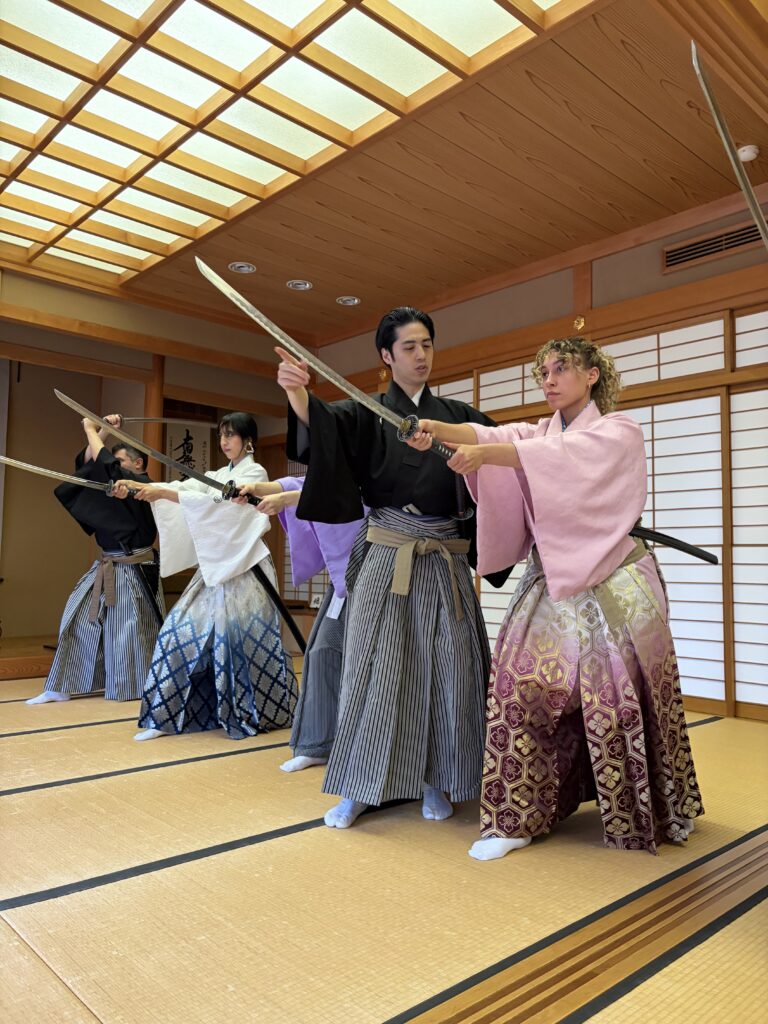
As rehearsals became more demanding, I discovered that balance depended far less on my legs thanI had initially expected. Instead, almost every movement relied upon consistent engagement of thebody’s centre.
Exercises involving directional changes, rotational turns, and transitions into hanmi required the abdomen and lower back to remain active throughout. Without that support, maintaining balance became considerably more difficult, particularly when combining footwork with sword techniques.
This became especially noticeable while rehearsing Saenoboru, the choreography I was studying atthe time. Several sequences required turning while changing direction with the sword, and I often found myself becoming unstable whenever I tried to complete them too quickly.
Rather than encouraging me to move faster, my instructor advised me to slow everything down.
Working at a reduced pace allowed me to concentrate on how my weight shifted between each stepand where I was losing stability. Instead of rushing through the choreography, I began paying attention to the mechanics of each movement. Gradually, those turning sequences became more controlled because they were built upon better balance rather than increased speed.
This was one of the most valuable lessons of my training. Improvement often came not from doingmore, but from doing less with greater accuracy. Slowing down allowed weaknesses to become visible, making it far easier to correct them before they became habits.
As my balance improved, movements that had once felt awkward gradually became more natural.
Rather than consciously thinking about staying upright or maintaining control, I could devote more attention to refining the quality of the movement itself.
Precision and Control
One of the biggest adjustments I had to make during training involved how I held the sword.
Before starting Kenbu, I assumed that maintaining control meant gripping the katana firmly throughout every movement. In practice, this created unnecessary tension, making the sword feel heavier and restricting the naturalflow of each cut.
During rehearsals, I became increasingly aware of how tightly I was holding the handle. Rather than remaining constant, the grip needed to adapt continuously depending on the movement being performed. Some techniques required greaterfirmness, while others depended on relaxing the handsto allow the sword to travel freely.
As I gradually released that tension, the difference was immediate. The sword moved more smoothly through each cut, and for thefirst time I was able to produce the characteristic swishing sound that indicates the blade is travelling correctly through the air.
It was a small but memorable milestone. Rather than achieving it through greater strength, it camefrom improving coordination and reducing unnecessary effort.
This experience changed the way I approached training more broadly. Again and again, I found that improvements came from refining technique rather than applying more force. Accuracy depended on efficient movement, careful timing, and allowing the body to work with the sword rather than against it.
Flexibility and Mobility
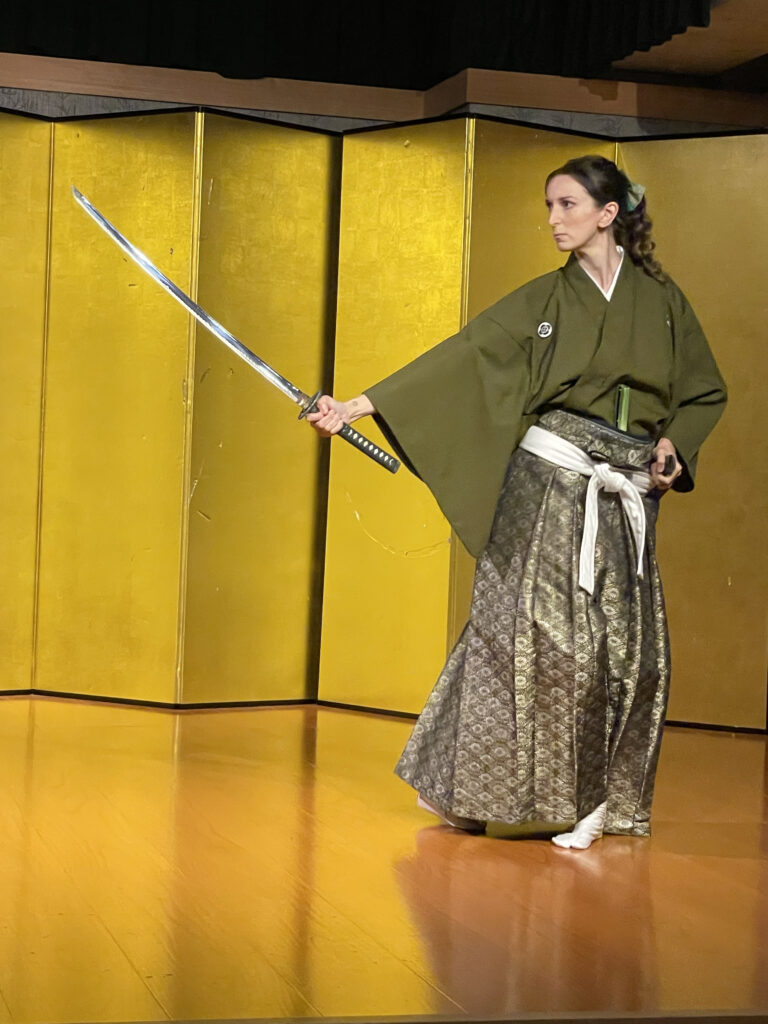
As my training progressed, I began to appreciate how much mobility contributes to effective movement in Kenbu.The choreography regularly shifts between low stances, rotational turns, extended reaches, and controlled changes of direction. Performing these transitions smoothly requires mobility throughout the hips, shoulders, spine, and ankles while maintaining stability through the centre of the body.
The contrast between sword and fan work made this especially noticeable.
Although both belong to the same performance tradition, they demand very different physical qualities. Sword techniques often emphasise grounded stability and clearly defined lines of movement, whereas fan choreography requires lighter, more fluid actions, particularly through the wrists and shoulders.
Initially, I found the fan surprisingly difficult. I became so concerned about opening it correctly or accidentally dropping it that I introduced tension into movements that should have felt effortless.
As handling the fan gradually became more familiar, that tension began to disappear. Instead of concentrating on the mechanics of the object itself, I was able to focus on moving continuously from one action to the next.
This taught me that mobility is not simply aboutflexibility. It also involves developing confidencein movement, allowing different physical qualities to coexist without disrupting the overall flow ofthe choreography.
Repetition and Muscle Memory
If there is one element of Kenbu training that has shaped my progress more than any other, it is repetition.
The same foundational exercises appear throughout almost every rehearsal. Walking patterns,turning exercises, stances, and sword techniques are revisited repeatedly, often with only small adjustments introduced each time.
Atfirst, I found this process frustrating. It sometimes felt as though I was practising the same material without making noticeable progress.
Only later did I begin to recognise how much was changing beneath the surface.
Movements that had once required complete concentration gradually became more familiar. Instead of consciously thinking about where each foot should be placed or how the sword should move, mybody slowly began recognising these patterns for itself.
This became particularly noticeable while learning the complete Saenoboru choreography.
Individual techniques that had originally been taught separately began connecting together much more naturally because the underlying movements had already become familiar through earlier practice.
Outside the theatre, I continued rehearsing whenever possible. Even without enough space to perform the choreography fully, practising posture, footwork, or grip with a simple stick helped reinforce the physical patterns I was developing during class.
Looking back, I realised that progress rarely arrived through dramatic breakthroughs. Instead, it accumulated gradually through consistent practice, often becoming visible only when movements that had once felt unfamiliar suddenly became routine.
When the Body Begins to Remember
One of the most rewarding aspects of training has been noticing how my relationship with movement has gradually changed.
During my earliest rehearsals, almost every technique required conscious thought. I was constantly reminding myself where to place my feet, how to hold the sword, when to turn, and how to coordinate everything together. It often felt as though my mind was trying to manage too many tasks at once.
Gradually, however, that began to change.
As the fundamental movements became more familiar, I found myself thinking less about individual techniques and more about the finer details of each movement. Instead of wondering where my feet should go next, I started noticing whether my weight was evenly distributed, whether my shoulders remained relaxed, or whether I was introducing unnecessary tension.
This shift did not happen suddenly. It emerged almost unnoticed through regular practice, as movements that had once felt awkward slowly became more natural.
Although there is still a great deal for me to learn, reaching this stage has given me a greater appreciation for the value of consistent training. Small improvements that seemed insignificant in one rehearsal gradually accumulated, creating changes that only became obvious when looking back over several months of practice.
Conclusion
Reflecting on my training so far, what stands out most is not any single technique I have learned, but the gradual development of physical awareness.
Kenbu has encouraged me to pay closer attention to posture, balance, coordination, and the many small adjustments that allow movement to become both efficient and controlled. Skills that initially appeared straight forward often demanded far more patience than I expected, while improvement susually emerged through careful repetition rather than dramatic moments of success.
There is still much for me to learn, but this stage of my journey has shown me that the physical foundations of Kenbu deserve just as much attention as the finished performance itself. The elegance seen on stage is supported by countless hours spent refining movements that audiences may never notice individually, yet which shape every aspect of the performance.
For me, that has become one of the most rewarding discoveries. Progress in Kenbu is builtg radually, through careful observation, consistent practice, and a willingness to refine even the smallest details. It is within those quiet moments of training that the physical foundations of the artare developed, one rehearsal at a time.