
News and Insights
2026.03.17Column
Worn History: Listening to the Past Through What We Wear
Moving between theatrical worlds has taught me that costume is never merely something worn—it is something lived in. Clothing shapes how performers move, breathe, and understand the stories they tell. My time working within UK theatre, followed by encounters with Kenbu in Japan, revealed striking parallels in how costume functions, even when the traditions themselves are worlds apart.
Whether in a rehearsal room or a dōjō, clothing becomes a point of entry into another way of moving and thinking. It does not simply represent the past; it invites the body to respond to it.
Experiencing History Through Costume
Working within theatre environments in the UK meant being constantly surrounded by garments from another age. Period clothing was regularly used as a practical tool, allowing performers to experience how layers of fabric, restrictive tailoring, and weight altered posture, breath, and presence. These garments were not decorative replicas; they were a means of understanding how historical bodies once inhabited space.
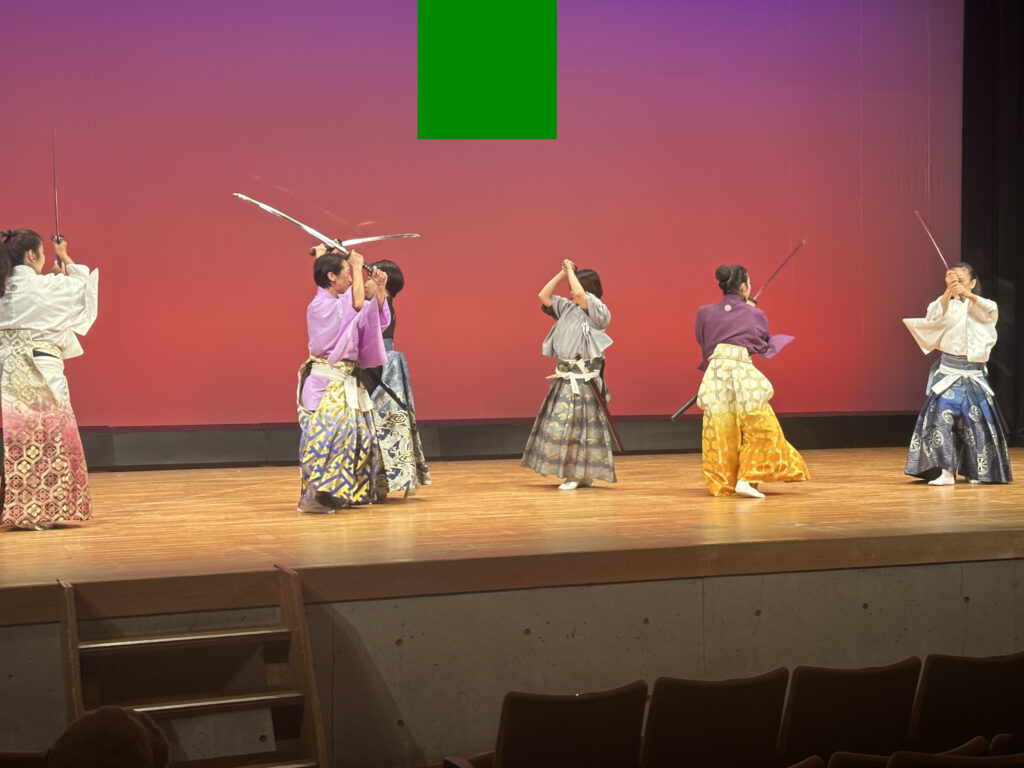
That same sense of embodied awareness resurfaced when I first encountered Kenbu. Watching performers dress in kimono, hakama, and obi, it became clear that these garments similarly guide the body. The hakama frames the legs, the obi stabilises the core, and the kimono restricts excess movement, encouraging discipline and focus. In Kenbu, costume is integral from the outset, shaping timing, spatial awareness, and intention.
As I researched further, a key difference began to emerge. In UK theatre, historical costume is typically worn for the duration of a production, allowing performers to step temporarily into another era. Samurai attire, by contrast, remains part of a continuous cultural practice—still worn today in martial arts, ceremony, and performance. One tradition is revived through theatre; the other continues to live beyond it.
Reading Colour on the British Stage
Within contemporary UK theatre, colour often functions as a form of visual shorthand. It shapes atmosphere and helps audiences read character and narrative without explanation.
In large-scale productions I experienced at the National Theatre, designers often used limited and carefully controlled colour to support clarity and focus. In The Grapes of Wrath(2024), costume designer Evie Gurney employed a palette of dusty greys, browns, and faded indigos to convey the physical and emotional exhaustion of life during the 1930s Dust Bowl. Secondhand garments were allowed to wear down visibly over time, inviting the audience to feel endurance and resilience rather than simply observe hardship.
A similarly deliberate approach appeared in Nye(2024–2025). Michael Sheen’s Nye Bevan remained dressed in red-striped pyjamas throughout his life’s journey, even within Parliament. This choice disrupted historical realism, keeping the character emotionally open and reflective rather than emphasising his position of power. Colour appeared sparingly, allowing individual tones to stand out and carry meaning over time.
This approach echoed practices encountered at Shakespeare’s Globe, where colour serves an immediate storytelling function. In a space without artificial lighting or elaborate scenery, costume colour helps audiences quickly read status and intent. Purples and golds suggest authority, white signals innocence, red evokes passion or violence, and black conveys grief or moral unease—most famously through Hamlet’s mourning attire. In Twelfth Night, Malvolio’s yellow stockings serve a similar purpose, making his self-delusion unmistakable from the moment he appears.
Colour and Restraint in Japanese Practice
In Japanese tradition, colour was shaped by systems that valued balance, context, and continuity, rather than drawing attention to itself. From court dress to warrior attire, colour functioned less as personal expression and more as an extension of social order, ethics, and seasonality. Meaning was shaped by how colours related to one another, to fabric, and to movement, rather than by intensity alone.
As warrior culture emerged, practicality and discipline increasingly guided dress. Earth-bound tones such as indigo, brown, and black supported focus and unity, while white carried layered associations of sincerity and resolve. Edo-period frugality fostered a subdued approach to colour, allowing refinement to emerge through construction and care rather than decoration.
Traditionally associated with shinishōzoku(death garments) and the ritual of seppuku, all-white attire signalled that a warrior had already accepted the ultimate consequence of their actions and taken full responsibility for their life and honour. While this practice no longer exists, the wearing of all-white garments in Kenbu continues today, where it symbolises purity, honour, and ethical clarity.
With this in mind, colour functions as a supporting element rather than a focal point, reinforcing discipline and clarity without dominating the performance. Movement, timing, and posture are allowed to carry primary meaning, ensuring that colour remains embedded within tradition rather than placed at the forefront of storytelling.
Wearing Discipline
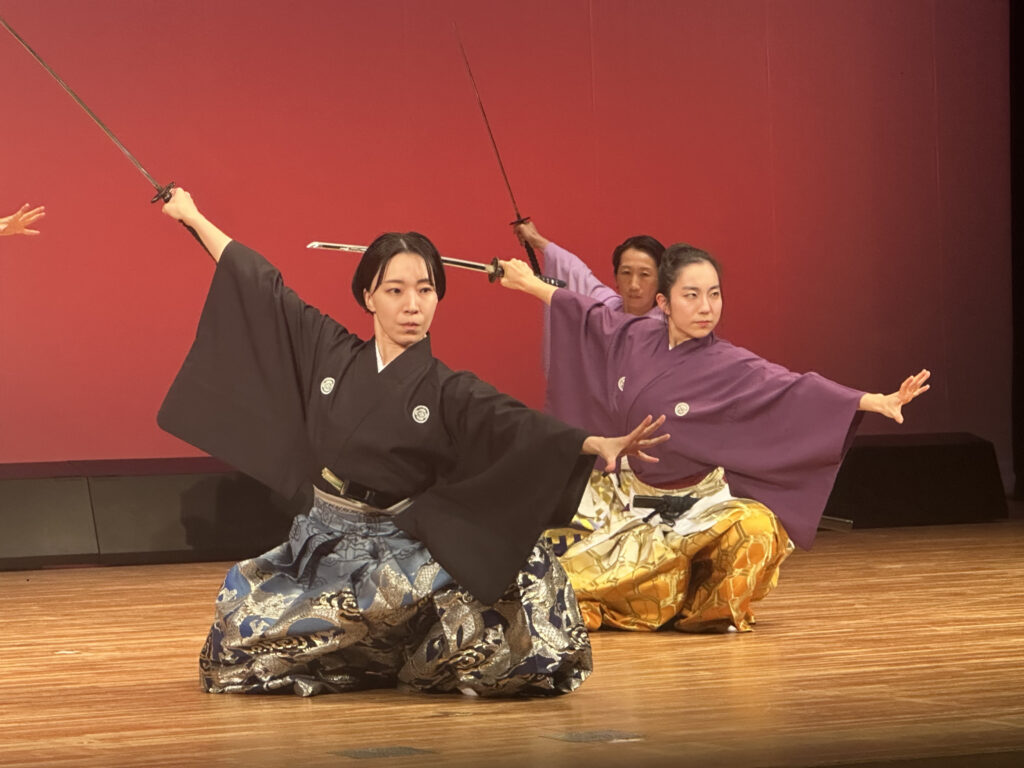
In Kenbu, costume is not a matter of presentation; it is part of the practice itself. The act of dressing marks a transition from everyday life into focused attention, guiding both body and mind into a disciplined state.
For beginners, kimono and hakama introduce structure. The weight of the garments, the process of tying the obi, and the awareness required to move correctly all encourage composure and attentiveness. Costume becomes an early teacher, shaping posture before technique fully develops.
As practitioners progress, the relationship deepens. Clothing is understood not only symbolically but functionally. The hakama supports wide stances and controlled turns, sleeves are managed to allow precision, and details such as layering or construction reinforce inherited values. Dressing becomes less instructional and more intentional, strengthening the practitioner’s connection to lineage and form.
At an advanced level, costume is no longer experienced as something worn for performance, but as something carried. Dressing becomes a deliberate transition—a moment of mental and physical alignment that marks the shift from everyday life into disciplined presence. Attire does not draw attention to the individual body; it steadies it, reinforcing commitment to the practice rather than the self.
Across all levels, Kenbu costume is not simply worn—it is inhabited. Through repeated practice, itconnects the practitioner to tradition while sharpening awareness in the present moment.
Beyond the Fabric
Looking across British theatre practice and Japanese martial performance, costume emerges as a form of communication that operates beneath language. Through weight, texture, tone, andrestriction, clothing shapes how stories are experienced and how bodies respond within them.Dress does more than reference the past; it invites attention to it. Garments influence stance andpacing, simplicity sharpens focus, and restraint creates space for meaning to emerge. Whetherstepping into period clothing for rehearsal or fastening a hakama before practice, the body is askedto adjust and listen.
In theatre, this engagement is often temporary. In Kenbu, it is sustained. Yet in both contexts, meaning arises not from spectacle, but from care. To listen to history through what we wear istorecognise that memory lives not only in texts or traditions, but in material choices and physicalhabits—carried forward quietly, through the body.
CARA SUTCLIFFE
カーラスクリフ
Cheshire, United Kingdom
Qualifications: MA in Theatre Practice obtained at Staffordshire University
Work experience: Shakespeare’s Globe, the National Theatre
Current status: Working Holiday Visa
Hobbies: Anime, Gaming, Theatre, Art