
News and Insights
2026.03.17Column
Movement as Meaning: Kenbu and Physical Theatre in Dialogue
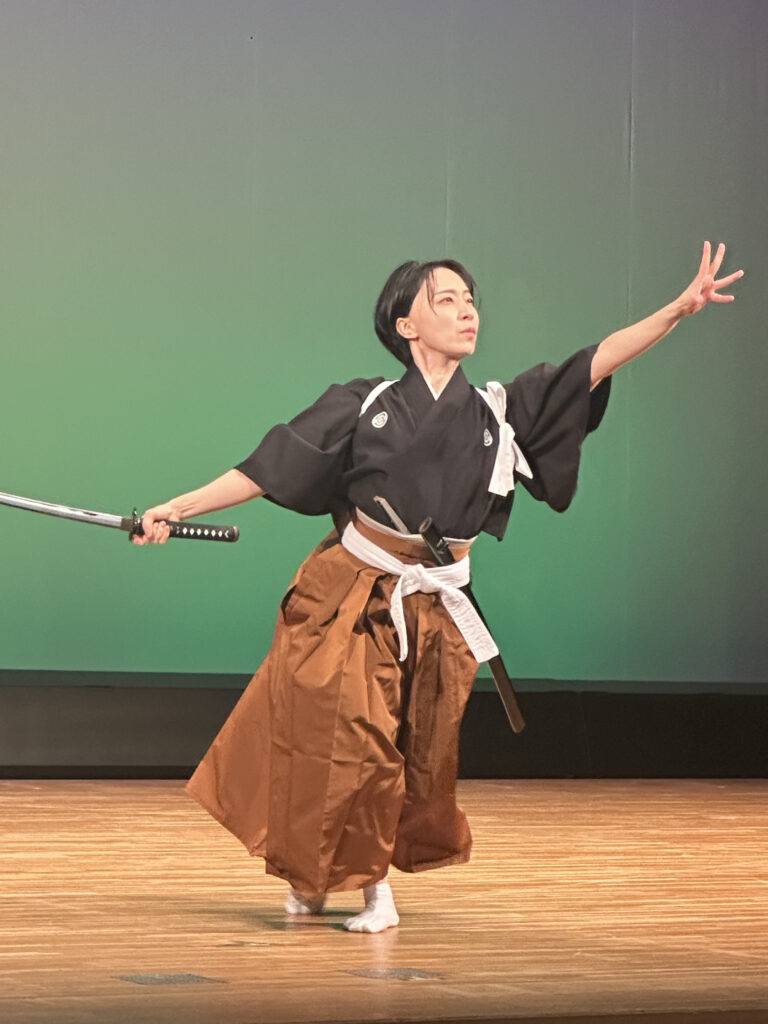
Kenbu is often described as a samurai sword dance, but on stage it operates as something more layered. Physical movement is inseparable from meaning. Poetry, breath, and stylised martial actions work together to create a physical language that communicates emotion and intention through the body. Movement does not decorate the poetry — it shapes how it is felt. In this way, Kenbu sits naturally alongside physical theatre practices in the UK, where the body often becomes the primary storytelling tool.
From Combat to Choreography
The movement vocabulary of Kenbu is rooted in traditional Japanese martial arts such as Kenjutsu and Iaido. Although adapted for performance rather than combat, the logic of real sword technique remains visible. Power is generated not through the arms alone, but from the body’s centre, or hara. Grounded stance, controlled weight shifts, and hip rotation allow energy to travel cleanly through the body and into the blade.
Kenbu places strong emphasis on flow and coordination. Upright posture, relaxed shoulders, and smooth transitions ensure movement remains continuous and intentional. Sword actions follow recognisable martial pathways — vertical, horizontal, and diagonal cuts — refined for clarity rather than aggression. Footwork supports this continuity, using sliding or advancing steps to maintain balance and directional focus across the space.
As explored in earlier posts, breath is a fundamental element of Kenbu, and within physical movement it acts as a stabilising force. Breathing patterns support balance, timing, and sustained control, occasionally marked by a brief release of air at moments of physical emphasis. Actions such as drawing and returning the sword are carried through with uninterrupted continuity, reinforcing a sense of composure and intention. In performance, these martial principles are redirected away from combat and towards expression, allowing disciplined technique to function as dance rather than defence.
Shared Physical Ground
UK physical theatre encompasses a range of practices that use movement as a primary means of communication. Rather than relying on extended dialogue or psychological realism, these forms build meaning through physical relationships, rhythm, and spatial composition. Text, when present, often operates as part of a wider physical structure rather than as the main carrier of narrative.
Seen through this lens, the relationship between Kenbu and UK physical theatre becomes clear. Despite their different cultural origins, both forms rely on disciplined physical action to shape meaning, trusting the body to communicate emotional and thematic content with clarity and precision.
This connection was particularly visible in the 2024 National Theatre production of Kin by Gecko. The work avoided a linear, dialogue-driven structure, instead using sustained physical sequences to explore migration, displacement, and belonging. Repetition in gesture suggested longing and memory, while sudden shifts in force and direction conveyed instability and threat. Narrative emerged through accumulation rather than explanation.
Language in Kin was fragmented and multilingual, not always intended to be fully understood. As a result, attention shifted towards physical cues — tension, pace, proximity, and weight — as the primary sources of meaning. This parallels Kenbu, where poetry is carried through movement quality and directional focus rather than verbal clarity. In both practices, experience is shaped through embodied action, asking audiences to read meaning in the body rather than in words alone.
When Motion Pauses
Drawing together these shared approaches, a key connection between Kenbu and physical theatre lies in their belief that movement can communicate more directly than language alone. In Kenbu, physical action deepens the poetry, reinforcing emotional weight and imagery, while in physical theatre, movement often reaches emotional territory that words struggle to access. A grounded stance, a sudden shift in direction, or a decisive cut can instantly suggest resolve, grief, or tension, inviting audiences to feel meaning rather than analyse it.
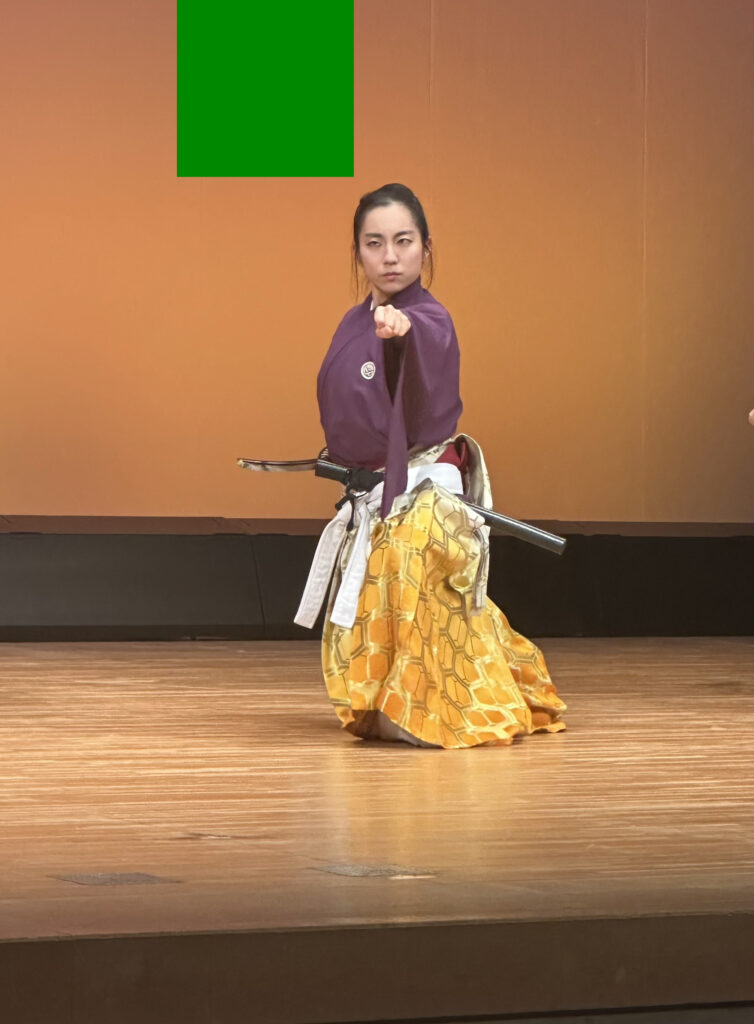
Within this physical language, stillness holds particular power. One of the most striking elements of Kenbu performance is its use of held shapes that appear at key moments within the poetic rhythm, acting as physical punctuation. These pauses allow emotion to settle, drawing attention to moments of conflict, honour, or reflection. Historically, Kenbu was performed to cultivate focus and mental readiness before battle, and that discipline remains visible on stage. Holding a precise stance demands concentration and control, pulling both performer and audience into the present moment.
This contrast between sustained motion and suspended stillness heightens impact, giving space for meaning to land. A similar use of restraint can be found in physical theatre, where freezes or tableaux sharpen focus and clarify intention. In both forms, stillness is not an absence of action but an intensified form of it, where silence and restraint carry as much expressive weight as movement itself.
Why the Body Matters
Kenbu and UK physical theatre, though shaped by different histories, share a respect for the body as a powerful storytelling instrument. Both demonstrate that movement — whether disciplined and contained or expansive and urgent — can hold narrative, emotion, and philosophy with clarity and force.
Placing Kenbu alongside contemporary physical theatre highlights how movement functions as a language in its own right. Precision, rhythm, and control become tools for meaning-making, reminding us that some of the most resonant moments on stage occur through the body in motion —and, at key moments, through the deliberate choice to pause.
CARA SUTCLIFFE
カーラスクリフ
Cheshire, United Kingdom
Qualifications: MA in Theatre Practice obtained at Staffordshire University
Work experience: Shakespeare’s Globe, the National Theatre
Current status: Working Holiday Visa
Hobbies: Anime, Gaming, Theatre, Art.