
News and Insights
2026.01.21Column
Embodied Metaphor in Kenbu and UK Theatre: The Expressive Power of the Sensu (Folding Fan)
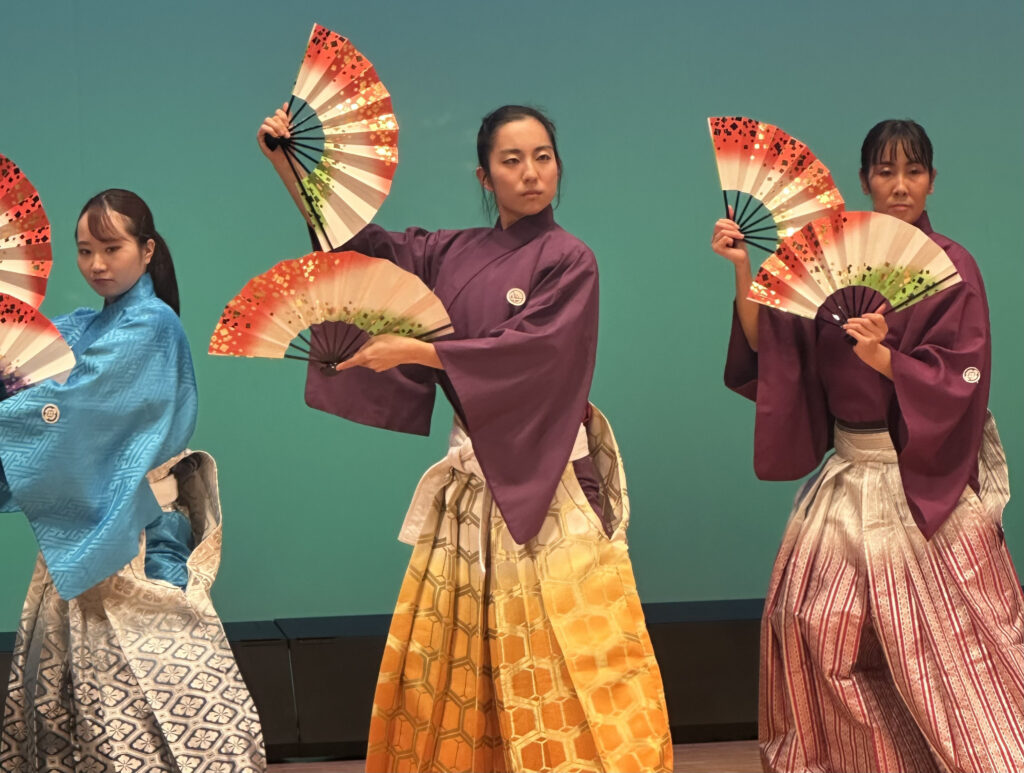
In Kenbu, meaning is carried through disciplined performance rather than elaborate design. Objects are deliberately kept simple, allowing symbolism to emerge through movement, rhythm, and intention. Central to this approach is the folding fan, which plays a vital role through mitate — the imaginative reinterpretation of a single object to suggest many forms.
Rather than disguising the object, Kenbu embraces its simplicity. The fan remains visibly a fan, and its meaning shifts through how it is held, moved, and positioned in space. This restraint places responsibility firmly on the performer, asking them to communicate transformation through clarity and control rather than visual illusion.
Parallels in UK Theatre: Minimalism and Metaphor
This approach feels immediately familiar when placed alongside UK theatre practices. From Shakespeare to contemporary physical theatre, many productions rely on minimal staging that encourages performers to build worlds through movement, rhythm, and presence.
Shakespeare’s original productions offer a clear example. With limited scenery and performed in daylight, meaning was shaped through spoken language and gesture. A torch might suggest night, a throne might establish a court, and the audience was directly invited to imagine what could not be shown. Objects gained significance through use rather than disguise — a principle closely aligned with Kenbu.
A contemporary parallel can be found in the 2022 touring production of The Ocean at the End of the Lane, where everyday materials were repeatedly reimagined to express memory and inner worlds.
Meaning shifted through movement and shared focus rather than technical spectacle, echoing Kenbu’s symbolic restraint.
The Role of the Audience: Co-Creators of Meaning
In both Kenbu and UK theatre, symbolism depends on active audience participation. Meaning is offered as suggestion rather than fixed image. When a Kenbu performer alters their stance and raises a fan, it may become a blade or a cup — not because it looks like one, but because the audience accepts the transformation.
Because the object remains visibly itself, its symbolic power rests on subtle changes in timing, posture, and spatial awareness. This invites a focused form of watching, where meaning unfolds gradually rather than being immediately presented.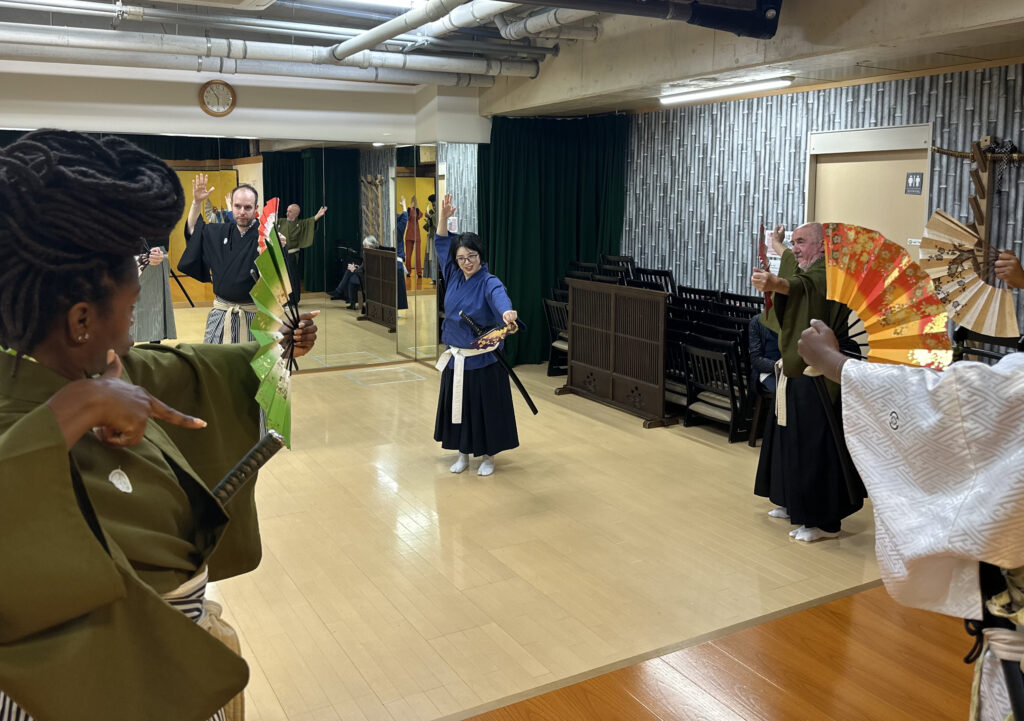
Shared Languages of Transformation
Across cultures, Kenbu and UK theatre demonstrate how imagination thrives within simplicity.
Whether through a folding fan, a torch, or an everyday object repurposed on stage, meaning emerges through disciplined use rather than realism.
These traditions remind us that performance does not rely on elaborate design to resonate. Instead, it grows from movement, suggestion, and a shared willingness to imagine — a quiet collaboration where the simplest object can carry remarkable emotional weight.
CARA SUTCLIFFE
カーラ スクリフ
Cheshire, United Kingdom
Qualifications: MA in Theatre Practice obtained at Staffordshire University
Work experience: Shakespeare’s Globe, the National Theatre
Current status: Working Holiday Visa
Hobbies: Anime, Gaming, Theatre, Art