
News and Insights
2026.01.16Column
Breath, Blade, and Poetry: The Sound of Kenbu
When Sound Leads the Movement
In Kenbu, sound is not something added to the performance — it forms its foundation. Spoken poetry, controlled breath, and subtle musical elements shape rhythm, emotion, and timing from within. Rather than responding to an external score, performers allow movement to emerge from the voice itself, with shigin acting as the connective thread between intention, action, and audience experience.
The cadence of a poem, the length of a breath, or the emphasis placed on a single word can subtly alter posture, pacing, and sword technique. In this way, sound becomes an active force in performance, guiding the body rather than accompanying it.
Voicing the Warrior
A defining sound element in Kenbu is traditional samurai poetry, which often explores honour, loyalty, impermanence, and personal resolve. When delivered through shigin, the vocal style is measured and restrained, with careful attention paid to pitch, phrasing, and breath control.
This discipline gives the poetry its strength. Vocal phrasing shapes the flow of movement, influencing how and when actions unfold. Because of this close relationship, movement is never decorative. Each physical choice is anchored to the spoken word, allowing sound and action to carry meaning together.
Sound as Atmosphere
Kenbu performances may include traditional instruments such as the koto or shakuhachi, used sparingly to create an atmospheric soundscape. These sounds sit alongside the voice rather than competing with it, reinforcing mood and pacing without overpowering the performance.
Occasional percussion or gong sounds may mark transitions or moments of intensity, helping to guide emotional focus. Even in contemporary settings where recorded sound is used, the principle remains the same: sound stays responsive and understated, shaped by breath and timing rather than fixed musical structure.
Listening From Within
For the performer, sound plays an internal role as much as an external one. The rhythm of the poem influences breath, focus, and emotional energy, while vocal phrasing guides the timing and precision of movement. Rather than counting beats or following cues, performers listen closely and respond in real time.
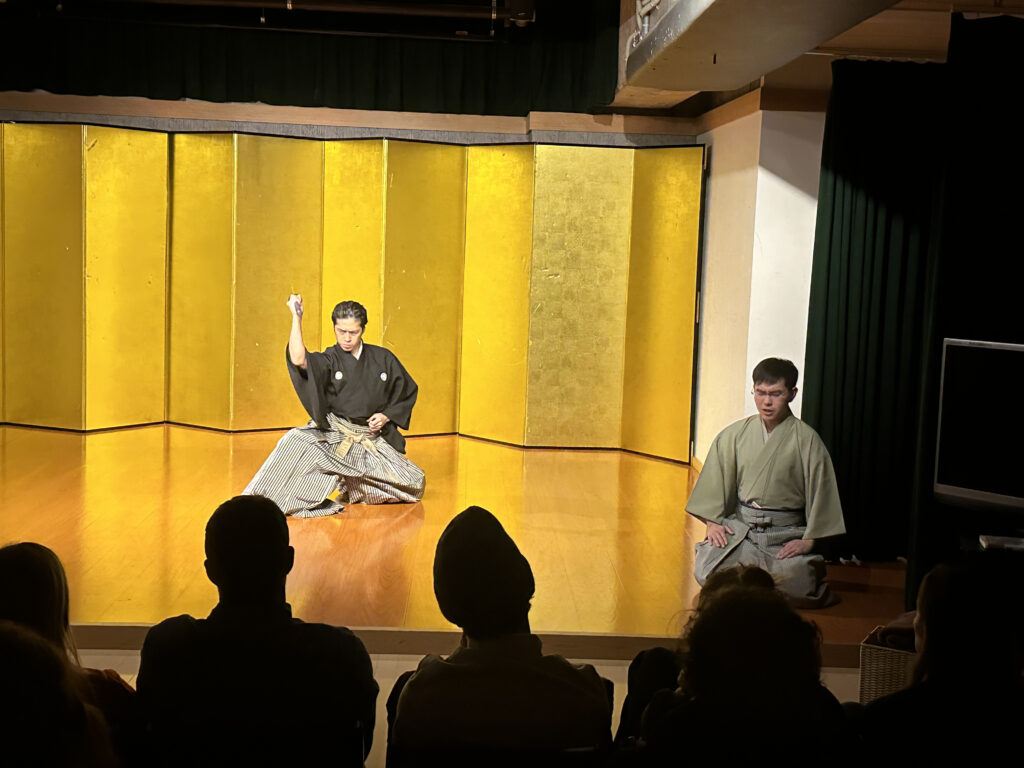
This was especially clear during a performance at Samurai Kenbu Theatre where shigin was delivered live by a professional reciter. Subtle shifts in breath and emphasis directly influenced the pacing and quality of movement. Transitions lengthened or tightened, gestures sharpened, and focus deepened in response. The audience, too, felt this exchange, with vocal intensity guiding attention and emotional engagement.

Familiar Echoes in UK Theatre
This idea of sound leading movement finds strong parallels in UK theatre, particularly in physical and movement-led work, where spoken text often functions as a score rather than background support. This approach is central to the work of Complicité. In Mnemonic at the National Theatre, which I watched in 2024, sound operated as a driving force behind the action. Repeated voices, layered audio, and rhythmic speech patterns prompted physical responses from performers, shaping shifts in memory and time. Movement appeared to emerge from listening, closely mirroring the way Kenbu performers respond to the cadence of shigin.
A similar dynamic can be seen at Shakespeare’s Globe, where the rhythm of Shakespeare’s language — often written in iambic pentameter — informs pacing, gesture, and physical energy.
With minimal amplification, performers rely on breath and vocal clarity, allowing language to drive physical expression. Pauses, stresses, and rhythmic patterns shape movement and presence, enabling storytelling to unfold through voice-led action. Across these forms, sound does not simply support movement — it generates it.
Why Sound Matters
Kenbu places sound at the centre of performance, uniting poetry, breath, and movement into a single expressive system. Through shigin and controlled vocal rhythm, sound provides both emotional depth and structural guidance, shaping how stories are embodied on stage.
When viewed alongside UK theatre practices — from Complicité’s sound-led physicality to the voice-driven performances at Shakespeare’s Globe — Kenbu reveals a shared understanding of performance rooted in listening, responsiveness, and breath. Across cultures and traditions, the principle remains consistent: when sound leads, the body follows — and meaning emerges through that connection.
CARA SUTCLIFFE
カーラ スクリフ
Cheshire, United Kingdom
Qualifications: MA in Theatre Practice obtained at Staffordshire University
Work experience: Shakespeare’s Globe, the National Theatre
Current status: Working Holiday Visa
Hobbies: Anime, Gaming, Theatre, Art