
News and Insights
2025.12.18Column
From London to Kyoto: Experiencing the Art of Kenbu, Japan’s Sword Dance
Hello there!
My name is Cara Sutcliffe, and I’m delighted to share my journey into the world of Kenbu—an art form that has already begun to reshape my understanding of Japanese performance,history, and cultural storytelling.
A New Chapter in a New City
I come from a small town in the north of England, but much of my adult life was spent in London,
working in large-scale theatres such as Shakespeare’s Globe and the National Theatre. Those yearsgave me a deep appreciation for craft, tradition, and the stories that transcend time.
Recently, I moved to Kyoto on a working holiday visa—a decision inspired by my fascination with Japan’s rich cultural landscape.
Kyoto, once the imperial capital for over a millennium, seemed the perfect place to learn about the country’s historical heart. Little did I know that this journey would lead me straight to Samurai Kenbu Theatre.
Discovering the Art of Kenbu
What drew me in first was how the theatre describes its art as: “ The Artistic Legacy of the Warrior’s Spirit.” Kenbu—often known as the “Sword Dance”—is a traditional performance art that blends the grace of the katana and the symbolism of the folding fan with the powerful recitation of poetry. The attire, including the kimono and hakama, is modelled after what samurai once wore, reinforcing the authenticity and heritage behind each movement.
This depth of history resonated deeply with me. Having worked around theatrical traditions back in the United Kingdom, I felt an immediate connection to this timeless practice and wondered what experience I might bring from my own background into this Japanese stage tradition.
Inside the Samurai Experience Class
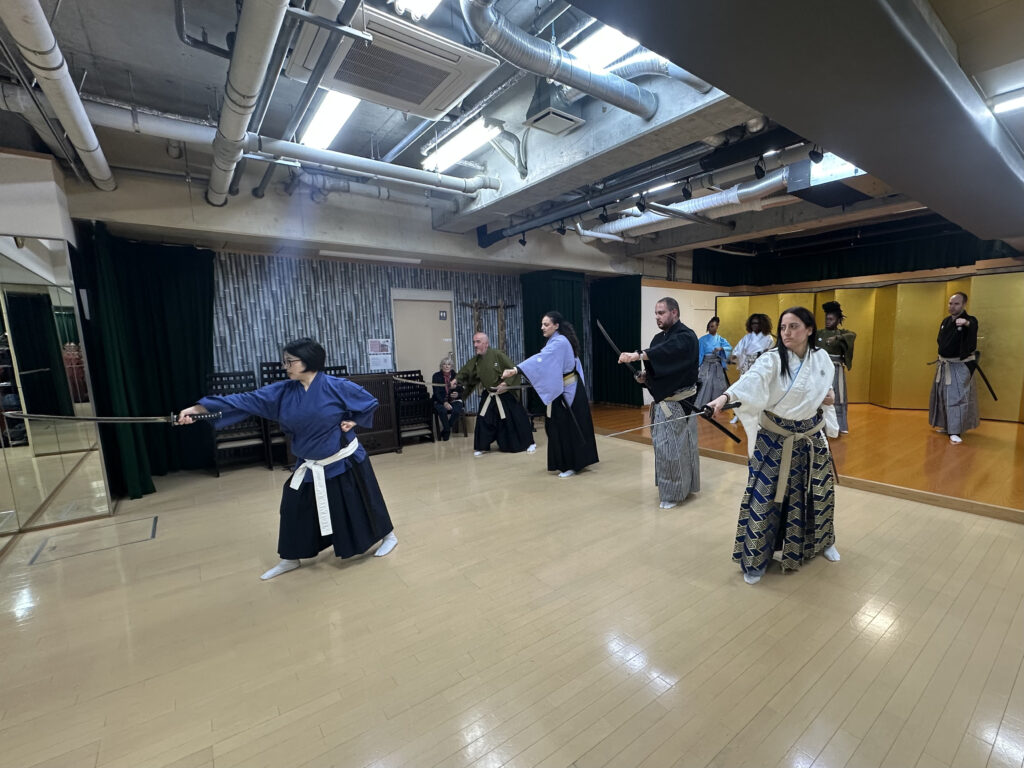
Samurai Kenbu Theatre offers a wide range of programs, from daily Kenbu show performances to hands-on samurai classes. I began by observing the classes, curious about how educational demonstrations here might compare to those in England.
From the moment attendees arrive, they are welcomed with warmth and professionalism—an atmosphere that mirrors the hospitality found in many theatres back home. Classes are held in English, creating an accessible space for international visitors. Even on my first day, I met many people from all over the world, each eager to immerse themselves in samurai culture.
As I watched the instructors work, I was struck by their passion. Each movement was demonstrated with precision, each historical reference shared with care. It reminded me of guided tours at Shakespeare’s Globe, where the storytellers didn’t simply relay information—they carried the weight of history with pride. In Kenbu, that same respect for tradition lives on. The instructors aren’t just teaching movements; they are sharing values that have shaped Japanese culture for centuries—“conviction, integrity, and responsibility for one’s words and actions.”
Experiencing the Kenbu Show
The theatre offers two performance options: a concise 10-minute show and a more detailed 40 minute version. Coming from a Shakespearean background where productions often run for 2-3 hours, I was fascinated to see how Kenbu encapsulates centuries of culture within such compact formats.
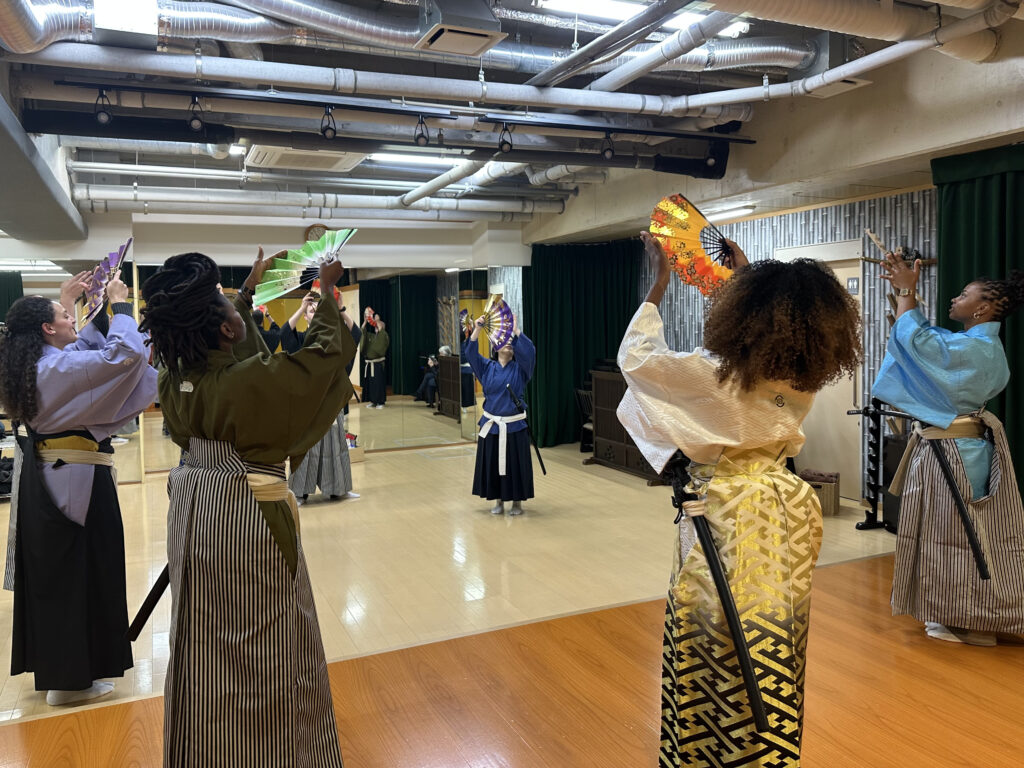
The show unfolds through a series of short, powerful portrayals of historical samurai figures and events. With minimalistic staging, the performers rely on disciplined movement, the gleam of the katana—the symbol of a samurai’s honor, discipline, and integrity—and the folding fan, a tool rich with layered symbolism. Each movement reflects the deep-rooted values that shaped samurai life for centuries, inviting the audience to witness the elegance and resolve that define Kenbu.
Much like a Shakespearean show that depends on language to conjure entire worlds, Kenbu asks its audience to imagine landscapes, battles, and inner emotions through physical expression. The folding fan itself serves multiple interpretive roles—sometimes representing a sake cup, a weapon, or a poetic symbol—allowing viewers to engage with the performance on both artistic and historical levels.A Universal Language of Performance
Watching Kenbu, I found myself reflecting on how performance art —across continents and
centuries—relies on the same core elements: storytelling, emotion, and human connection. Though the techniques can differ, the intention remains remarkably universal.
My experience so far has been nothing short of magical. Kenbu is not only a performance—it is a
living heritage. And as Samurai Kenbu Theatre continues to share this tradition with today’s
audiences, it becomes a bridge between Japan’s historic past and the contemporary world.
I look forward to delving deeper into this remarkable art form, and I’m excited to share more insights as my journey continues. Thank you for joining me as I step into the timeless realm of the samurai.
CARA SUTCLIFFE
カーラ スクリフ
Cheshire, United Kingdom
Qualifications: MA in Theatre Practice obtained at Staffordshire University
Work experience: Shakespeare’s Globe, the National Theatre
Current status: Working Holiday Visa
Hobbies: Anime, Gaming, Theatre, Art