
News and Insights
2026.05.06
Kenbu and Bushid ō : The Way of the Warrior in Practice
Where Philosophy Meets the Body
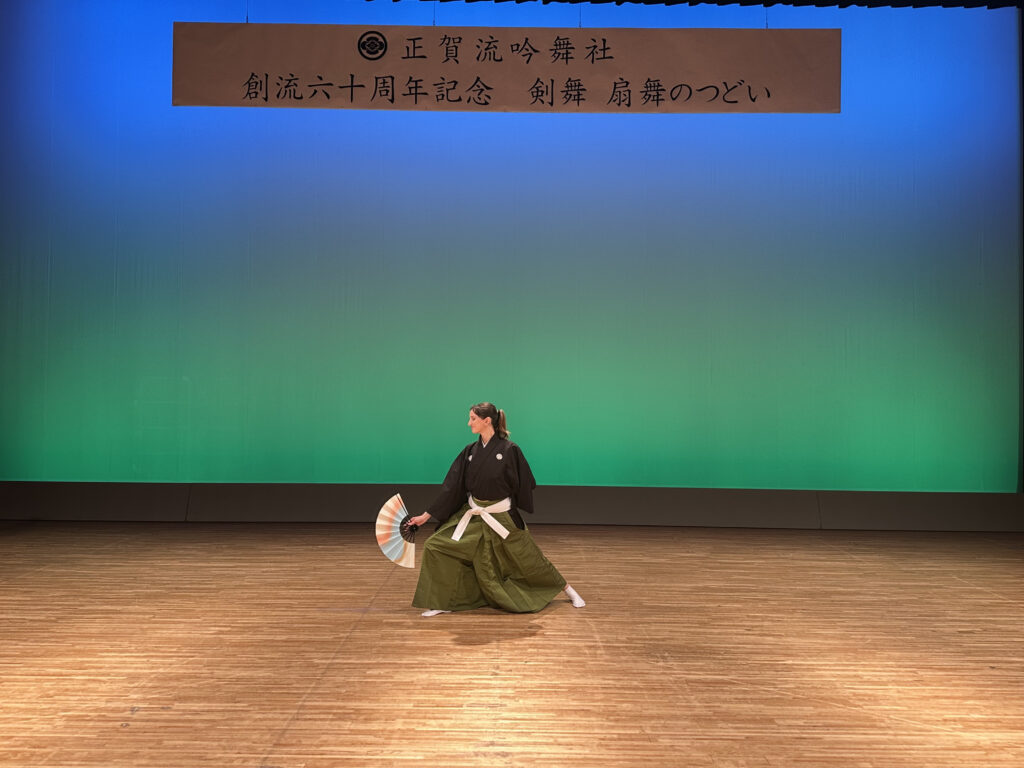
When first encountering Kenbu, what often stands out is not only the choreography itself, but the composure carried by the performer. Even in moments that suggest conflict or tension, the movement remains measured and controlled, creating a quiet intensity that draws the audience in without needing to project outward.
Through both observation and practice, I began to feel that this quality is closely connected to Bushidō, often described as “the way of the warrior.” Rather than functioning as a fixed set of rules, Bushidō reflects a way of thinking shaped by values such as discipline, loyalty, and clarity of action. These principles historically guided the lives of the samurai, influencing not only how they fought, but how they carried themselves in everyday life.
In Kenbu, these ideas are not explained directly, but experienced physically. The way a performer stands, pauses, or moves through space begins to communicate something deeper, allowing philosophical ideas to take form through the body rather than through words. Spending time in Japan, I also began to recognise that elements of this mindset still exist in everyday life, visible in small gestures of awareness, patience, and consideration. Experiencing Kenbu within this wider context made it feel less like a reconstruction of the past and more like a continuation of something still present.
What the Form Begins to Show
As I spent more time practising Kenbu, I began to notice how these values are embedded within the movement itself — not as abstract ideas, but as something that gradually becomes visible through the way the performance is carried.
There is a consistent sense of dignity within the work, particularly in moments that might otherwisefeel dramatic. Rather than pushing expression outward, the performer maintains composure, allowing meaning to emerge through subtle shifts in timing and focus. Themes such as loyalty and responsibility often seem to sit quietly beneath the surface, shaping the tone of the performance without needing to be explicitly stated.
Over time, it becomes clear that strength in Kenbu does not come from force, but from precision. Movements are deliberate and restrained, and it is this clarity that gives them weight. This balance between control and intention reflects the influence of Bushidō, where discipline and awareness guide both action and presence.
Learning Through Practice
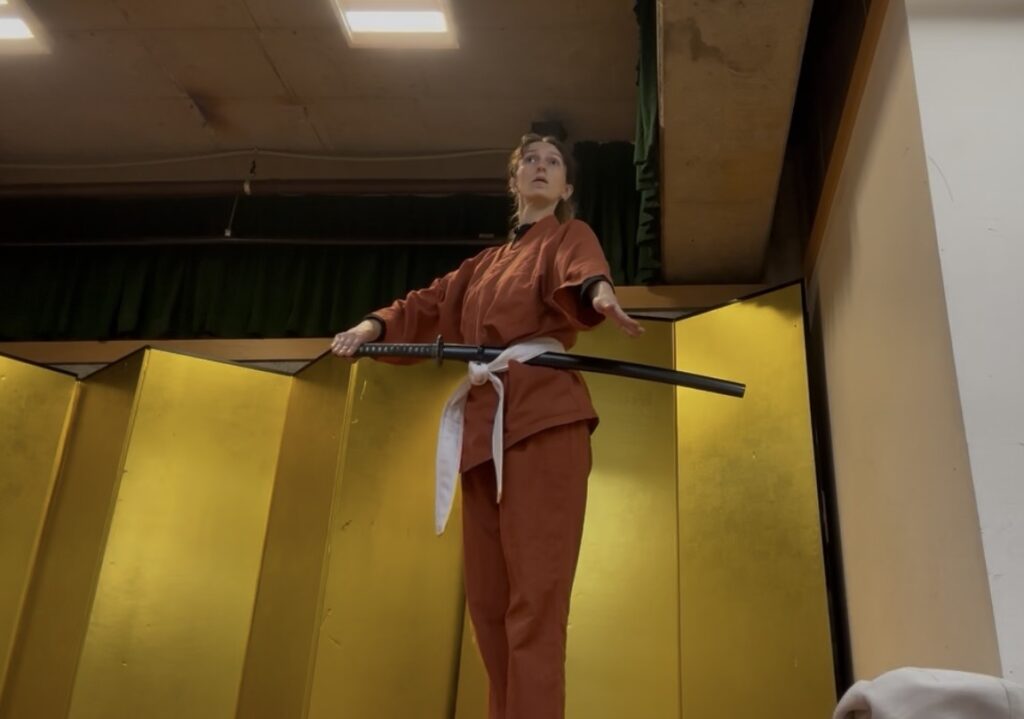
Training in Kenbu gradually reveals how closely these ideas are connected to the process of practice itself. Rehearsal is not only about learning sequences, but about developing a consistent and attentive way of working over time.
Sessions often begin with formal gestures such as bowing, which establish focus and a shared sense of respect within the space. From there, movements are repeated carefully, sometimes many times, with attention placed on small adjustments rather than large changes. This repetition can feel slow at first, but gradually builds a deeper understanding, allowing both the physical and mental discipline of the form to settle more naturally.
This emphasis on careful, repeated practice also reflects a broader cultural approach in Japan, where craft is developed gradually through consistency and attention. Experiencing this within Kenbu made the training feel connected to something wider, where discipline is not simply a requirement, but a way of working.
When reflecting on my earlier theatre training in the UK, I found a small point of connection in the rhythm of rehearsal processes. It was common to revisit the same material multiple times, not in search of immediate perfection, but to deepen understanding over time. While the structures are quite different, this provided a personal way for me to relate to the idea that progress develops through sustained attention.
Composure in Motion
One of the most challenging aspects of Kenbu is the level of physical control it requires, and this feels closely connected to the Bushidō emphasis on composure and self-mastery. Movements often appear simple when observed, yet in practice they demand continuous attention to balance, posture, and breath.
During my early training, even the foundational “suriashi”, or sliding footwork, revealed this. Gliding across the floor while maintaining an upright torso and steady centre required sustained focus, particularly through the legs, where the bent stance created a constant sense of grounding. What initially felt like a basic exercise gradually became something closer to a form of moving meditation, where attention needed to remain steady throughout.
As I was introduced to “hanmi”, the half-body stance, this sense of composure became more complex. The body turns slightly to reduce exposure, requiring coordination and spatial awareness while maintaining stability. At first, this felt unfamiliar, particularly when transitioning between sides. Over time, the focus shifted away from simply completing the movement and towards maintaining clarity within it.
Working with the sword further reinforced this understanding. Holding the katana introduced a heightened sense of awareness, and I quickly noticed how tension in my grip disrupted both movement and intention. When I held it too tightly, the action became restricted. As I began to release that tension and adjust my grip more sensitively, the movement felt more fluid.This highlighted that control in Kenbu is not about force, but about precision and restraint.
This also reminded me of aspects of actor training, where alignment and physical intention influence how a performance is perceived. This parallel helped me personally to understand how a stable and grounded body can support clearer movement.
Acting with Intention
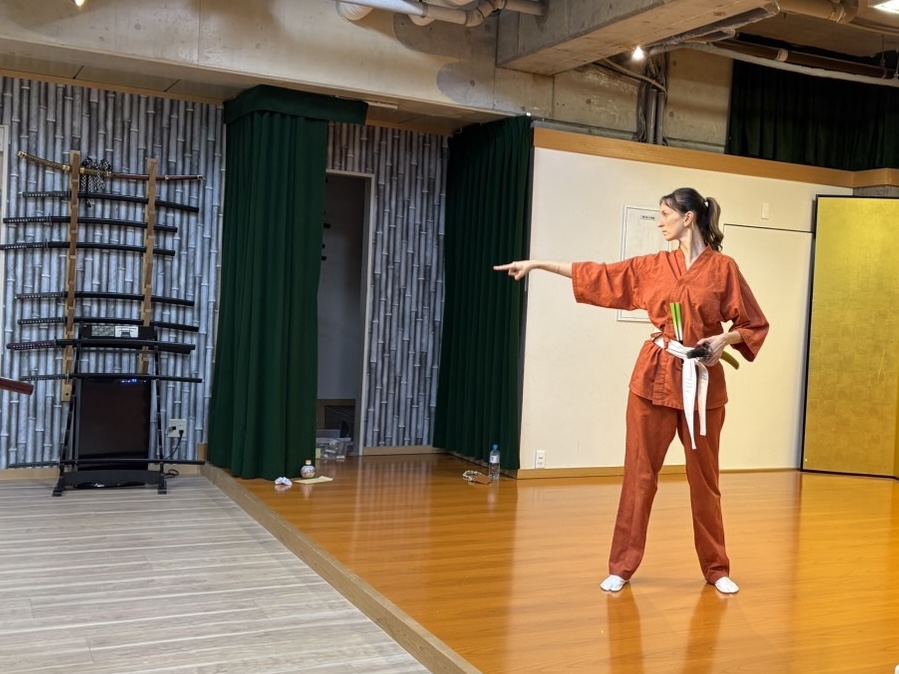
Another aspect that became clear through practice is the importance of intention. In Kenbu, movement does not exist for visual effect, but emerges from a clear sense of purpose.
When working with the sword, I was often encouraged to visualise an opponent and consider the exact direction of each action. Without this clarity, the movement quickly lost its meaning.
This approach reminded me of a method I explored during my MA training, associated with Konstantin Stanislavski. While developed in a very different context, it offered a personal point of reference for understanding how meaning can emerge through action rather than discussion.
This shifts the focus away from how something looks and towards why it happens, allowing intention to shape the movement from within.
The Power of Restraint
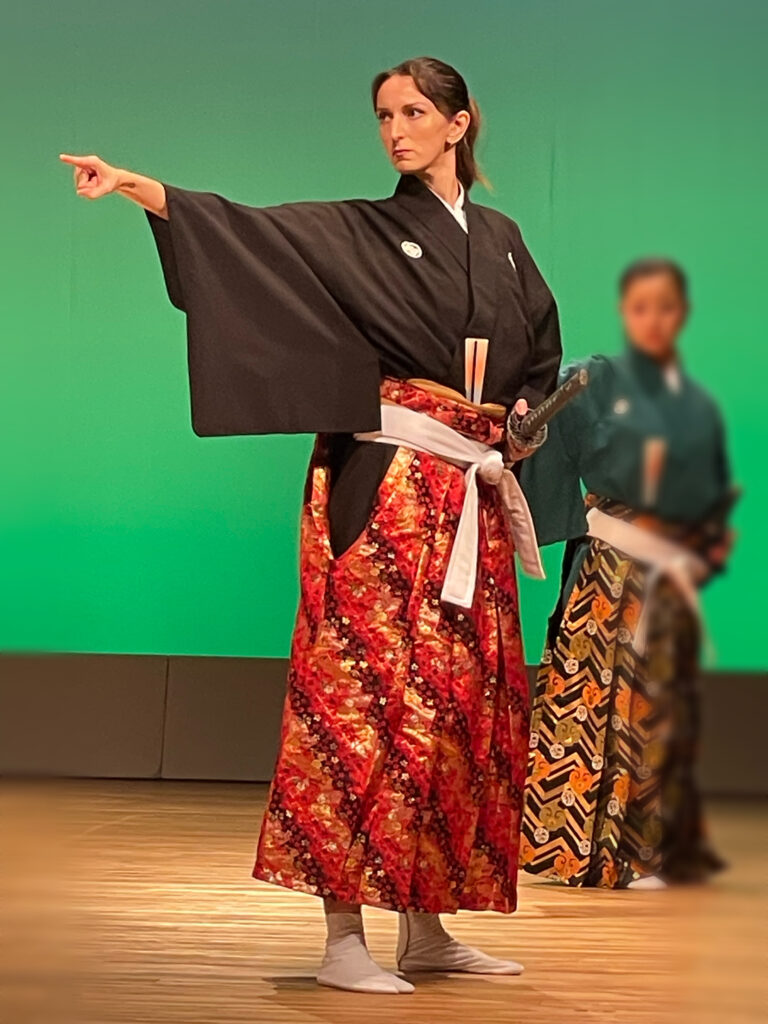
One of the most distinctive aspects of Kenbu is its use of restraint. Emotion is rarely expressed in anovert way, yet it remains present throughout the performance.
Instead, feeling is suggested through timing, stillness, and small shifts in focus. A pause can carry as much weight as a movement, creating a quieter intensity that encourages closer attention.
Experiencing daily life in Japan also gave me a way to reflect on this quality, where communication often relies on subtlety and awareness rather than direct expression. This helped me better understand how restraint functions within Kenbu — not as a limitation, but as a way of creating depth.
While this felt different to performance styles I had previously experienced, it was not entirely unfamiliar to me. It gave me a way to reflect on how restraint can invite a more active form of engagement from the audience.
A Shift in Mindset
Over time, it becomes clear that Kenbu is not only shaping the body, but also influencing the way practice is approached. The emphasis on repetition, focus, and attention begins to affect how each session is experienced.
There is a gradual shift towards allowing time for details to settle, rather than trying to achieve immediate results. This creates a deeper level of engagement, where progress is measured through consistency rather than speed.
This approach felt closely aligned with a broader attitude towards learning that I encountered in Japan, where patience and sustained effort are valued. Experiencing this within Kenbu encouraged a more attentive and reflective way of working.
Reflecting on my previous training, I found that returning to the same material over time similarly allowed understanding to deepen. In this sense, the process itself becomes central, shaping not only the outcome, but the way the work is experienced.
A Practice That Continues
Through Kenbu, Bushidō becomes something that is experienced rather than explained. Its values appear through the way movement is approached, how training is structured, and how performers carry themselves within the space.
For those with a background in theatre practice, there may be points of connection in the emphasison discipline, intention, and presence. However, for me, these connections simply offered a way to reflect more clearly on the experience of training.
Seen in this way, Kenbu offers more than a representation of samurai tradition. It becomes a living practice in which philosophical ideas continue to exist through the body — not as something distant, but as something actively encountered through ongoing practice.
CARA SUTCLIFFE
カーラスクリフ
Cheshire, United Kingdom
Qualifications: MA in Theatre Practice obtained at Staffordshire University
Work experience: Shakespeare’s Globe, the National Theatre
Current status: Working Holiday Visa
Hobbies: Anime, Gaming, Theatre, Art