
News and Insights
2026.03.23Column
Fierce Spirits: Women’s Journey in Kenbu
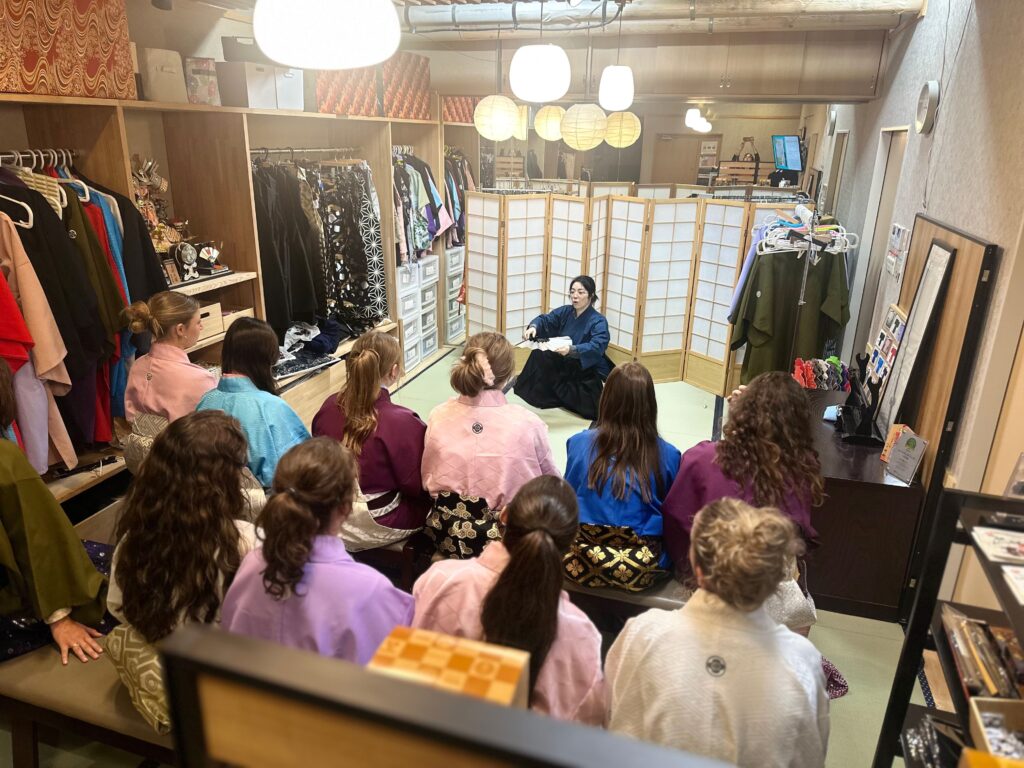
Roots of Strength: Women and the Samurai Legacy
In feudal Japan, the martial world of the samurai was predominantly male, yet women were never absent from its structure. Their roles were complex and layered — sometimes visible in moments of conflict, but more often embedded within the quiet architecture of family life, education, and governance.
History remembers figures such as Tomoe Gozen and Nakano Takeko, whose courage in battle has come to symbolise female martial strength. Yet such figures were exceptional. More commonly, women cultivated discipline, composure, and resilience through their responsibilities within the household and community. As educators, organisers, and custodians of lineage, they embodied a quieter, but no less essential, expression of the same spirit associated with the warrior ethos.
Women’s relationship with the sword itself was also shaped by social convention. During the Edo period, it was considered improper for women to touch a sword directly; when handled, it would be wrapped in the sleeve (tamoto) of a kimono. Instead, tools such as the kaiken or naginata became more closely associated with women’s roles in protection and self-defence. These distinctions did not reflect a lack of capability, but rather the structure of the society in which women moved.
Seen in this light, women’s place within Kenbu is not simply a matter of later inclusion, but part of a longer process of cultural adaptation. While formal Kenbu was historically dominated by men, the discipline, restraint, and internal strength cultivated by women in other contexts created a foundation through which they could engage with — and eventually shape — the art
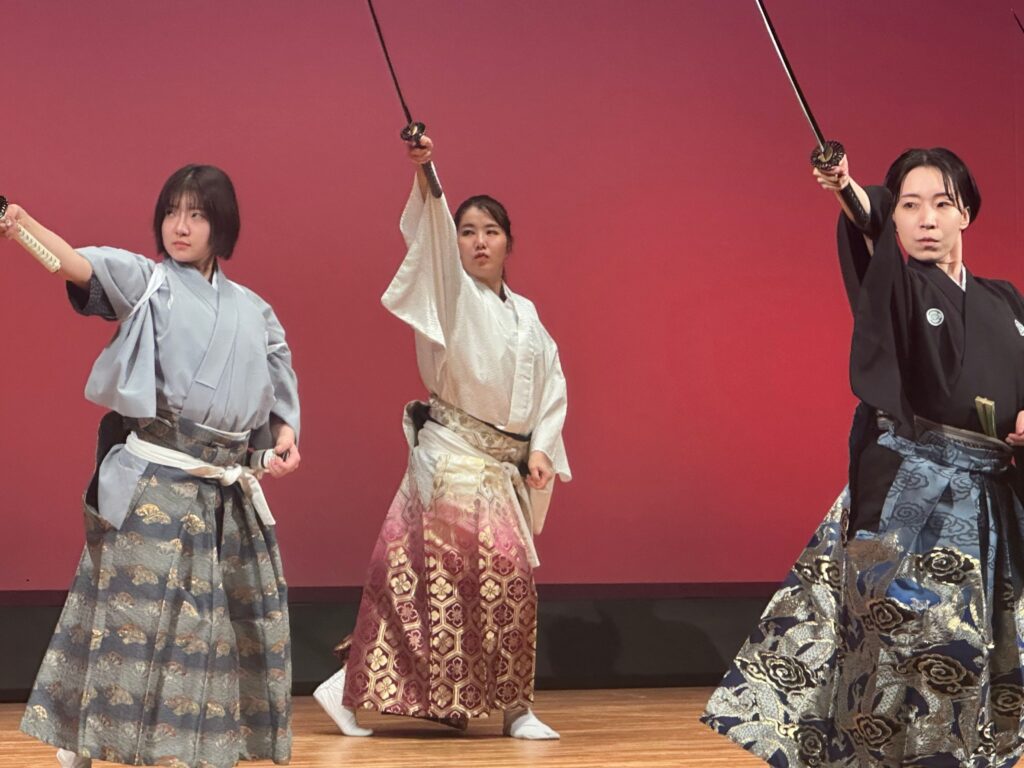
Shibu: A Dance of Discipline and Elegance
A major pathway for women into Kenbu emerged through the use of the folding fan (sensu). As Kenbu developed during the Meiji period, it became increasingly common for women to perform with the fan rather than the sword — a shift that aligned with forms of movement and expression already familiar to many women.
At the same time, early Kenbu practitioners were not necessarily drawn from elite samurai classes trained in refined artistic traditions. The expressive use of the fan within Kenbu therefore developed gradually, as practitioners sought ways to embody the imagery and emotional depth of poetry.
Drawing from a range of influences, they expanded the expressive vocabulary of the form through experimentation and adaptation.
Within this evolving practice, women’s participation became increasingly significant. Their familiarity with fan-based movement provided a natural entry point, and as more women engaged with Kenbu, this contributed to a growing refinement in timing, gesture, and expressive nuance.
During periods when sword-carrying was restricted — including after the Haitōrei Edict and again following World War II — fan-based performance became more prominent. Through forms such as Shibu, practitioners continued to cultivate the precision, breath control, and rhythmic discipline central to Kenbu.
In this context, the fan is best understood not simply as an alternative to the sword, but as a medium through which the art expanded. Women’s increasing involvement did not merely sustain the tradition during periods of change — it played a meaningful role in shaping its expressive depth and direction.
Beyond the Battlefield: The Stewardship of the Okusama
While the image of the female warrior is compelling, strength within samurai culture was not confined to combat. Women were expected to embody composure and refinement, while also carrying significant responsibility within the household.
As educators of the next generation, they internalised the values of the samurai and ensured their continuity. The role of the okusama— the lady of the household — reflects this clearly. Far from being peripheral, she functioned as a central figure, managing finances, coordinating retainers, and maintaining the social and operational stability of the household.
This broader understanding of strength reveals resilience not only in moments of conflict, but in sustained responsibility and leadership. Seen in this light, women’s presence in Kenbu is not simply an adoption of martial imagery, but an extension of deeply rooted practices of discipline and control.
Continuing the Lineage
Today, women participate fully in Kenbu as performers, teachers, and masters, demonstrating the same precision, dignity, and martial spirit as their male counterparts. Their work draws not only on historical narratives of battle, but also on the wider cultural roles women have long inhabited.
For contemporary practitioners, Kenbu offers a synthesis of breath, movement, posture, and rhythm— a discipline that cultivates both external form and internal composure. Women’s contributions are not limited to preservation; they actively shape how the art is interpreted and performed today, ensuring its continued relevance and vitality.
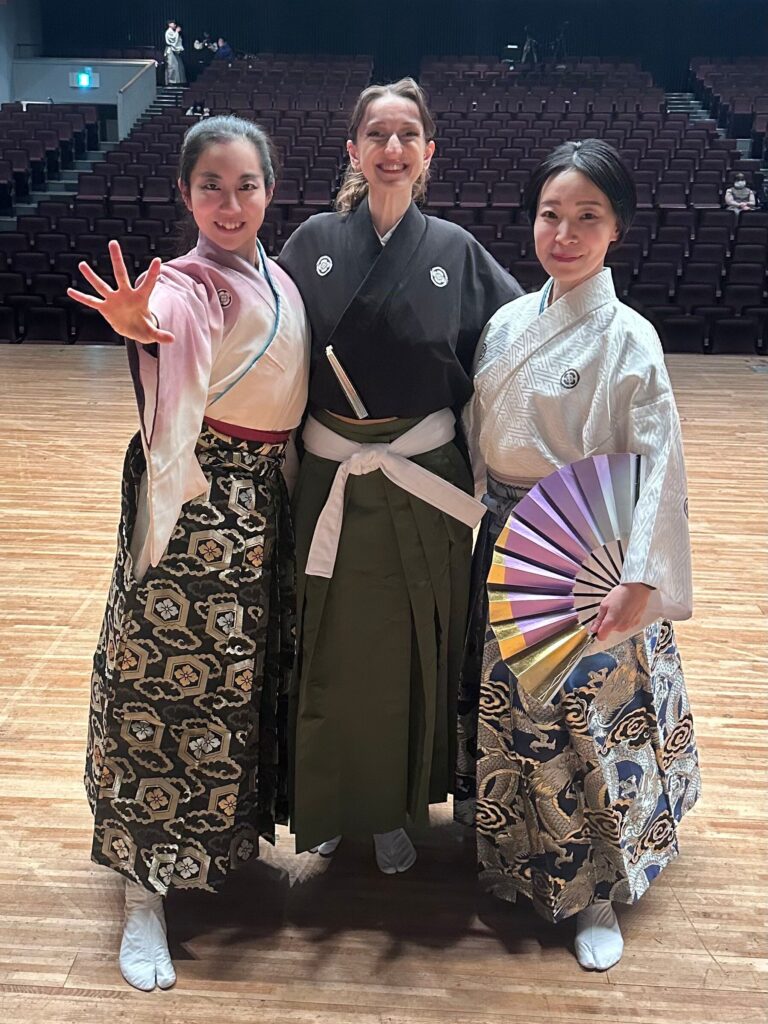
Parallel Evolutions on Stage: Women in British Theatre and Kenbu
Across cultures, performance has long reflected — and quietly reshaped — social structures. A well-known example can be found in Elizabethan theatre, where women were prohibited from appearing on public stages. During the lifetime of William Shakespeare, female roles were performed by trained boys, whose disciplined technique allowed audiences to accept and engage with these portrayals.
The Restoration of 1660 later marked a significant shift, as women were permitted to perform,reshaping the atrical practice and perception. Over time, British theatre continued to evolve, renegotiating how femininity could be expressed and understood.
A more understated transformation can be observed in Kenbu. As women became more visible within the art, their presence contributed to subtle but meaningful changes in its expressive character — particularly through movement, timing, and sensibility.
In both contexts, women did not simply enter an existing structure; they influenced how expression itself was realised. Their participation highlights how artistic traditions evolve not only through preservation, but through the perspectives and practices of those who engage with them.
Embodied Expression Across Time
Women in Kenbu carry forward both visible and quiet forms of strength, uniting technical precision with cultural and artistic depth. Through their continued practice, they sustain and develop the tradition, ensuring that Kenbu remains a living and evolving art.
In this way, Kenbu becomes more than a reflection of the past. It is an ongoing expression of discipline, interpretation, and presence — shaped across generations, and continually redefined through those who practise it.
CARA SUTCLIFFE
カーラスクリフ
Cheshire, United Kingdom
Qualifications: MA in Theatre Practice, Staffordshire University
Work experience: Shakespeare’s Globe, National Theatre
Current status: Working Holiday Visa
Hobbies: Anime, Gaming, Theatre, Art